
STEWING ON HOPE
This story was created by our partners at the Heavy Table, a weekly culinary newsletter dedicated to covering the best food and drink of the Upper Midwest. Back them on Patreon to receive four distinct email newsletters focused on dining, the restaurant business, spirits, and home cooking: http://www.patreon.com/heavytable
James Norton / Heavy Table
Northern winters are endlessly entertaining, which is to say they’re all a unique blend of delightful and horrific. You get some randomly allotted assortment of charming snowfalls, inconvenient icestorms, depressingly warm weeks, alarmingly Arctic weeks, and a series of seemingly endless thaws and freezes as you work your way through 3-5 distinct False Springs on your way to Real Spring.
Seeing as we’re in the middle of False Spring #3, with evidence of snow on the horizon next week, today seemed like an appropriate time to embrace - maybe for the last time in a while - the winter practice of making comforting, slow-cooked food. Roseanne Pereira’s classic Irish Stew couldn’t be more appropriate for the month of Saint Patrick’s Day, and Ropa Vieja is just an all-timer of a dish that needs to be tasted to be fully believed. — James Norton
CLASSIC IRISH STEW
Lamb and potatoes are the core of this nourishing classic supper.
By Roseanne Pereira
Roseanne Pereira / Heavy Table
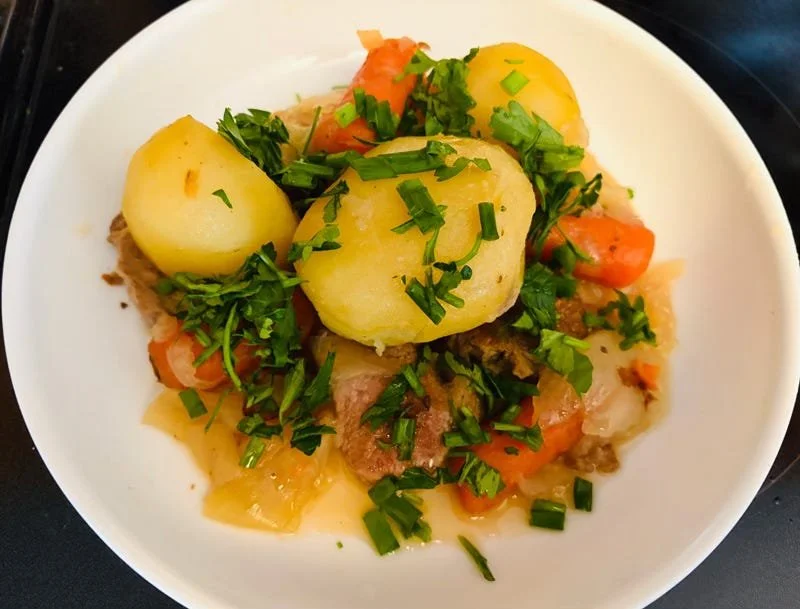
This Irish stew adapted from the Ballymaloe Cookery School in County Cork is rustic, simple, and forgiving. The core ingredients are straightforward: lamb, potatoes, onions, carrots, salt, pepper, lamb stock if you have, otherwise water will do, and a sprig of thyme. Some swear by adding roux at the end to thicken the stew, but a modern day take is to mash down one or two potatoes for the same effect.
Speaking of potatoes, I learned when I lived in Ireland that it was not uncommon for multiple potato dishes to be in one meal - sometimes as many as four or five! When using potatoes in this recipe, it’s ideal to avoid floury ones. I opted for waxier Yukon golds, but Russets are a no-no. Meat, grain, and sugar can mean different things in Ireland vs. the US.
Here, I went for rib lamb chops. The Irish recipe says the ideal is “gigot or rack chops no less than one inch thick.” In the olden days mutton was used, meat from the older (2-3 years old) animal, or even hogget, meat from an animal between 1 -2 years— but in modern times and in the U.S., it’s easier to find lamb (meat from sheep less than 12 months old) in grocery stores. The reason people used mutton in the past was that the long slow cook time allowed for the tougher meat to become broken down. As I said, it’s a rustic, practical dish.
If you are interested in other historic Irish practicalities, I hope you’ll make and eat rutabaga this Saint Patrick’s Day. Known in Ireland as Swedes, or Swede turnips, rutabagas can grow to enormous sizes and are inexpensive. Eating them helped with survival during the infamous times of famine. One of these root vegetables could go a very long way.
IRISH STEW
Adapted from Darina Allen’s Ballymaloe Cookery Course
2 ½ - 3lbs lamb chops, fat trimmed, Chops should be no less than 1-inch thick
8 medium or 12 small carrots
8 medium or 12 small onions
8-12 non-floury potatoes
Salt
Freshly ground pepper
3 ¾-4 ¼ lamb stock or water
1 sprig thyme
Garnish:
1 tablespoon + 1 teaspoon, freshly chopped parsley
1 tablespoon + 1 teaspoon, freshly chopped chives
Preheat the oven to 350 degrees, then prep your vegetables, peeling the onions and carrots. Leave small onions whole or quarter larger ones. If small, carrots can be left google, otherwise, chop into chunks. Peel the potatoes.
Brown lamb chops, then remove from pot. Add carrots and onions. Once these are coated in fat, add some of the meat back in. Layer the carrots and onions (this may require removing some veg and adding back in later) until all remaining meat is in the pot, remembering to season each layer with salt and pepper.
Deglaze the pan/pot by adding the water or stock. Add the peeled potatoes on top of the mixture. They will steam as the dish cooks. Season the potatoes. Add a sprig of thyme.
Bring to boil, then cover with lid and put into the oven for about 1.5 hours.
After the stew is cooked, you may want to de-grease it. You can do this by pouring off the liquid into a separate saucepan, de-greasing, and reheating.
The stew usually improves in flavor if kept for a day or two anyway, so what I do is refrigerate the dish overnight so fat solidifies, then easily pick off the shards of solidified fat the next day and reheat the stew to serve. Garnish with minced chives and parsley. The stew can be served with soda bread, colcannon, or a root puree – maybe even a rutabaga mash.
COOKING NOTE PER DARINA ALLEN: “It’s worth remembering the old saying ‘a stew boiled is a stew spoiled’. If a stew is allowed to boil fast for even a short time the protein and gelatine in the meat becomes tough and chewy rather than meltingly tender.”